Automation in technical writing: From layout to translation
What could your technical writers achieve if a significant share of their working time were not spent on layout formatting, translation packages, and manual data transfer? Automation in technical writing is not a vision of the future but everyday practice. Component content management systems (CCMS) now take over repetitive tasks completely and thereby create capacity for value-adding work. The effects are measurable, often within the first year. The return on investment is usually 12 to 18 months.

Michael & Anna
Head of technical writing & technical writer
Michael has introduced time tracking. The result shocked him: a large share of working time goes to routine tasks. These include adjusting layouts and creating translation packages. Retyping data from SAP and checking terminology manually belong here as well. Little time is left for what matters most: creating content, understanding machines, keeping users in view.
Anna is highly qualified, but she spends her time on tasks that require no professional expertise.
The problem: When repetitive tasks become a full-time job


Automation needs structure and quality assurance

Automation does not run by itself. Michael recommends starting with a single area such as layout automation, securing success there, and then continuing. Automation also works only with standardized processes, because if every technical writer works differently, no system can automate anything. In addition, unrealistic expectations are a common stumbling block. Full automation does not exist, because people remain responsible for content, quality, and approvals.
Automation creates time, but only quality assurance ensures that automated processes also deliver correct results. Automated terminology checking works only with a well-maintained glossary. Automated layouts require correctly defined templates. And delta translations succeed only if modules are cleanly structured.
What automation changes in concrete terms

For Michael
Head of technical writing
✓ Free up capacity for value-adding work Instead of 60% of working time flowing into repetitive tasks, the team focuses on content quality and user orientation.
✓ Make processes transparent and controllable Automated workflows deliver traceable cycle times, and bottlenecks become visible.
✓ Prove ROI to executive management Concrete metrics such as hours saved and reduced translation costs make the value of the investment measurable.

For Anna
Technical writer
✓ An end to layout formatting Templates take over the design automatically, and Anna concentrates on the content.
✓ Sources of error eliminated Automated data import and terminology checking systematically prevent careless mistakes.
✓ One click instead of triple the effort Multi-format publishing generates PDF, HTML, and other formats from a single source.
For the company
✓ Systematic quality improvement Consistent layouts, verified terminology, and error-free technical data reduce audit findings and liability risks.
✓ Scalability without a proportional increase in headcount More documentation sets, more languages, more variants, without the effort growing linearly.
How AI extends rule-based automation

Rule-based systems reliably automate repetitive processes, such as layout, export, and data import. AI complements these processes by providing support where people still do manual work today: in metadata assignment, terminology checking, and suggestions for reusing existing modules. AI does not take over entire tasks. It prepares decisions that people make and approve.
The prerequisite for this is a cloud-based infrastructure with central data storage and structured content. Companies that rely on the cloud today are laying the foundation to introduce AI-supported assistance in the future without elaborate migration projects.
Conclusion: Automation determines strategic impact
Anna now spends her time on what she is qualified for: creating content, understanding machines, keeping users in view. Repetitive tasks are not fate, they are a process problem that can be solved.
The question isn’t whether you should automate. The question is: How long do you want to invest 200 hours per year in layout formatting when a system does it in seconds?
Discover products now
Whitepaper
How to create a user-friendly operating manual
How can you create a user-friendly operating manual that does more than meet legal requirements? A document that delivers valuable content about your product to customers and technicians in every situation, clearly presented and visually appealing? We answer this in this practical guide.
Further resources

Product Flyer
ST4 Cloud Automation
Download now
Checklist
10 Questions for Successful AI Projects in Technical Documentation
Download now

Blog post
Modularization in technical documentation: less effort, higher quality
Read more
Previous article
← Modularization in practice
Next article
Quality assurance in technical documentation →

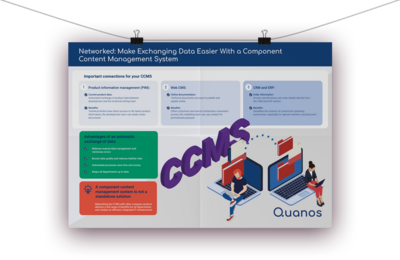
CCMSs such as Quanos SCHEMA ST4 now reliably automate four core areas: layout formatting, translation management, data import from ERP and PLM systems, and terminology checking. Multi-format publishing comes on top, where one and the same content is automatically published as PDF, HTML, or other formats. Together, these tasks tie up as much as 60 percent of the available working time in many technical writing teams.
The biggest individual effects arise in layout and translation. Automatic layout formatting alone saves roughly 200 working hours for 50 documentation sets per year, because content and design are consistently separated. Technical writers like Anna write the text, and the system applies templates automatically. In translation management, costs are typically reduced by 60 to 70 percent, because only new or changed modules are passed to the translation agency. The return on investment is usually 12 to 18 months.
Yes. A CCMS is the technical prerequisite for systematic automation. It separates content from layout, manages modules for reuse, and provides interfaces to ERP, PLM, and translation systems. Without this basic structure, automation is only piecemeal and error-prone. Quanos SCHEMA ST4 was developed for exactly this use case: as a central content management system for technical writing teams in mechanical and plant engineering.
Automation measurably increases quality. Automated layout templates are always consistent, automated terminology checking finds deviations that are missed manually, and automated data import eliminates typos in technical specifications such as dimensions, weights, or performance values. The result: fewer inquiries from service, fewer audit findings, and lower liability risks thanks to uniform safety instructions.
The CCMS automatically detects which modules have been newly created or changed since the last translation. Only these are exported and passed to the translation agency. Translated texts then flow back automatically into the right documentation modules. With eight languages per documentation set, the effort without automation is considerable. With a system like Quanos SCHEMA ST4, this process is reduced to a few controlled steps.
Rule-based automation reliably handles recurring processes: layout, export, data import, format changes. AI adds functions with contextual understanding: automatic metadata, semantic terminology checking in real time. It makes suggestions for module reuse. It also performs context-based quality checks. What a rule-based system cannot do, pattern recognition, semantic consistency, and foresight, becomes possible through AI. The foundation for this is a cloud-based infrastructure with central data storage.
Yes, the effect is often especially noticeable for smaller teams. If a technical writing team consists of two to three people and still handles several languages and many document versions, repetitive tasks carry disproportionate weight. Automation creates the capacity that is missing for content work: understanding machines, keeping user needs in view, developing documentation further. Instead of being used for formatting, Anna works on the things her qualifications are actually needed for.
The most effective starting point lies in the areas with the greatest loss of time. In most technical writing teams, these are layout and translation. Both can be automated quickly with a CCMS such as Quanos SCHEMA ST4, without requiring a complete process redesign. The recommended path: record time spent, identify the biggest cost drivers, and start with a clearly defined pilot process. Measurable results usually emerge within the first year.