From information chaos to a single source of truth
Distributed product information costs companies time, money, and a competitive edge. Although they describe the same product information, technical writing and Aftersales & Service teams often work with separate data. A single source of truth (SSOT) creates a central data foundation for consistent, strategically useful information.

Anna & Peter
Technical writer & service manager
Monday morning, 8:45 a.m. Anna opens an email: Hydraulic pump type 340 is being replaced by type 350, and the change needs to be made in every document. That means 18 operating manuals, an online help system, and training materials, adding up to at least two workdays. Three floors down, Service Manager Peter is searching three systems for the right spare part. The technician is waiting. So is the customer.
The core problem: separate information worlds

The business impact: information as a risk factor

The strategic answer: a structured information architecture

Structured metadata: Information is given context through attributes such as product applicability, target audience, language, and version. This enables automated distribution and intelligent search.
Metadata in Detail
What an SSOT changes for technical writing and service

For Peter
Service manager
✓ Enter a serial number and find the right spare part immediately
The exact match, including compatibility notes and successor part numbers.
✓ Place an order without switching systems
Ordering is built in, so there is no need to keep searching manually.
✓From 25 minutes of searching to under 1 minute
Dramatically less time spent handling a service case.

For Anna
Technical writer
✓ Make one change and keep everything current
All operating manuals, online help, and training materials stay in sync.
✓ No manual updates across multiple systems
Content module logic keeps information consistent automatically.
✓ From 2 workdays to 30 minutes
Substantially less effort when engineering changes are made.
Conclusion: product information as a strategic competitive advantage
Since the company adopted an SSOT, Anna spends 50% less time searching for information. Translation costs have fallen by 40%, and Peter finds spare parts in under a minute. Compliance risks have measurably declined.
The question isn't whether you need a single source of truth. The question is how long you can afford to treat product information as a cost factor instead of a competitive advantage.
White paper
How to create a user-friendly operating manual
How do you create a user-friendly operating manual that does more than meet legal requirements? One that gives customers and technicians valuable product information for every situation, presented clearly and in a visually engaging way? This practical guide answers those questions.
From the SSOT to a future-ready information architecture

Cloud as a foundation: scalability and global availability
Cloud-based information architectures provide scalability and global availability, and they are a prerequisite for AI-driven processes. Service technicians in Vietnam, Brazil, or Sweden can access the same current information at any time, without local IT infrastructure.
The cloud addresses a challenge that is difficult for on-premises systems to handle. It lets companies update all information channels worldwide at once, synchronize changes automatically, and scale without infrastructure investments.
The digital twin of product information
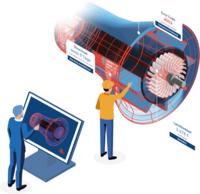
In a Digital Information Twin, information is not static; it evolves with the product. If engineering changes a component, the digital representation updates automatically everywhere, from Anna's documentation to Peter's spare parts catalog and maintenance instructions.
This kind of digital twin takes the single source of truth one step further. It goes beyond centralized data storage to create a living digital information model that grows alongside the physical product throughout its lifecycle.
Additional resources

Customer story
Single source of truth at Bühler
Read the customer story


Blogpost
Why Separate Content, Structure, and Layout?/
Continue reading
Next article
Content Strategy as a leadership tool →

A single source of truth (SSOT) means that each type of information has one authoritative source. For example, technical specifications may come from the PLM system, marketing copy from the CMS, and spare parts data from the ERP system. What matters is that each channel gets its content from the designated source. When a component changes, one update in the relevant source brings all downstream documents up to date immediately.
A single source of truth (SSOT) is the principle of maintaining each piece of information in one place. A single source of content (SSOC) is its documentation-specific application, with content modules created once and reused across different documents, formats, and languages. Quanos SCHEMA ST4 applies this principle from the component content management system to the service portal.
No. The concepts overlap, but they are not identical. MDM focuses on master data such as product numbers or supplier information. SSOT goes further by covering content, documents, variants, translations, and publication across channels. In machine and plant manufacturing, MDM provides the data foundation, while SSOT controls who sees that data, when, and where, whether in the operating manual or the spare parts catalog.
Technical writers can spend up to 30% of their work time searching for current information and manually reconciling document versions. An SSOT eliminates this effort. Engineering changes flow automatically into all affected documents. Teams need to commission new translations only for changed content modules, rather than for the entire document. The result is up to 40% lower translation costs and much shorter turnaround times.
Service technicians and Aftersales & Service teams lose time every day because spare parts information, maintenance instructions, and product data are maintained in different systems and are often out of sync. An SSOT creates a central data foundation. Enter a serial number to find the right spare part, including successor part numbers, and place an order right away. A search that takes 25 minutes today takes under one minute with an SSOT. This improves the first-time fix rate and measurably reduces service costs.
Variant diversity is one of the biggest challenges in machine and plant manufacturing. A well-designed SSOT addresses this with clear metadata. Each piece of information receives attributes such as product version, configuration, region, and validity period. These attributes automatically determine which content goes into which document, market, or language version.
Yes. This is a critical advantage, especially in machine and plant manufacturing. Safety information, CE documentation, and standards-compliant warnings are maintained once in the SSOT. From there, they are automatically added to all relevant documents. When a safety notice becomes outdated, it is updated centrally rather than in 18 separate operating manuals. This reduces liability risk and makes audits significantly easier.
The most common mistake is a big-bang approach that tries to change everything at once. A step-by-step approach is more effective. Start with one product family, assign clear data ownership, and set up a lean data model. You can show measurable results after just three months. Then expand gradually by connecting more departments, systems, and language versions.
Implementation typically takes 6 to 18 months, depending on the complexity of the existing system landscape. The ROI often appears earlier. Pilot projects for one product family usually deliver measurable results after just three months, for example through shorter maintenance times, lower translation costs, or a higher first-time fix rate in service. Defining the right KPIs from the outset matters. These include search time, time to publish, reuse rate, and compliance effort.
An SSOT can pay off quickly, especially for mid-sized machine and plant manufacturers. Companies that support many variants, multiple languages, and an international service network lose efficiency and revenue every day without a central data foundation. Getting started does not need to be a major undertaking. A clear data owner, a consistent taxonomy, and clean interfaces are enough to begin. You can scale from there.