Maintenance Strategies: Why Repairs Alone Aren’t Enough
Machinery outages don’t always occur out of the blue. With the right maintenance strategies, companies can avoid these unpleasant and, above all, expensive surprises. This blog post shows you how to deal with maintenance strategically, how to conquer risk, and how to stop unplanned production downtime from even happening in the first place.

One unforeseen fault on one of your machines, and your entire production process grinds to a halt. The technician’s on their way and—best-case scenario—replacement parts are shipped express delivery. Production downtime, stressed out staff, rush delivery surcharges, and customers that now have to wait longer for their orders—all this is expensive, annoying, and creates additional planning work. And you ask yourself how nobody could have seen a serious technical failure like this coming.
Whether or not a mechanical failure catches you off guard like this depends largely on your maintenance strategy. By choosing the right one, you can manage risk, keep costs under control, and plan maintenance efficiently. New maintenance strategies are possible today, due in part to digitalization.
The maintenance pyramid shows the approaches you can take:
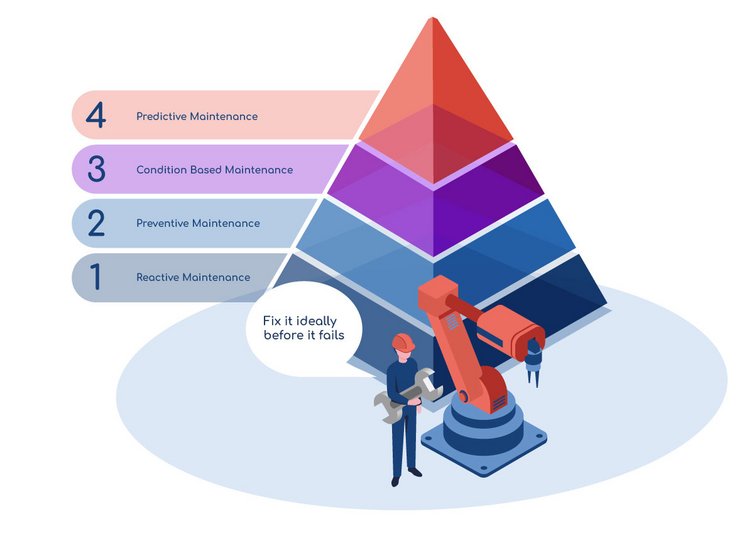
Reactive Maintenance: When putting up with a fault is not a disaster
An example of a sudden fault is depicted at the start of this blog entry—and one that you'd think should be avoided at all costs. However, this reactive maintenance strategy can be useful:
- If you keep spare parts in stock.
- If the necessary spare parts can be sourced quickly and your staff can replace them easily.
- If you have a backup machine waiting that you can switch to if your main one fails.
- If a fault occurs so rarely that the cost of preventively replacing a component prematurely wouldn’t be economically viable.
In these cases, the advantages of reactive maintenance are clear—you have no ongoing maintenance costs, the effort required for managing spare parts is negligible, and you avoid unnecessary maintenance and, in turn, unnecessary expense.
Tip: Find the spare part you’re looking for with the right tool
When repairs are urgent, identifying the correct replacement and wear parts quickly—as well as having the correct technical documentation directly to hand—are crucial. Quanos SIS.one, a software package for the easily creating spare parts catalogs and service information systems, supports you in this process.
Preventive Maintenance: Why it’s often better to take preventive measures than let a fault take you by surprise
While a short amount of downtime is tolerable if some components need to be repaired, other faults are more critical and can seriously jeopardize your production capability. Such a failure constitutes a real risk to your company’s success. But you can protect yourself against situations like these.
If you perform preventive maintenance and bear the comparatively low and easily calculable costs, production stoppages won’t bring you to your knees and you can plan in short-term downtime for maintenance in advance. Your machinery stays fit and your customers stay happy.
Tip: To avoid unnecessary maintenance costs, choosing the right time for maintenance is crucial. If you think of it like a car’s cambelt, which should be replaced every six years or 70,000 miles, you can use the time the machine has been running or amount of usage as your guide. The next strategy will show you an even better way to identify the optimum time to perform maintenance.
Condition-Based Maintenance: How to find out that your machine really does need maintenance now
The condition-based maintenance strategy solves a central problem you encounter in production—finding the right time for maintenance.
- If you perform maintenance too soon, you replace parts that are actually still functional. This results in you incurring unnecessary costs.
- If you wait too long, you risk a fault occurring that leads to expensive production downtime.
Condition-based maintenance relies on the current status of your machine, just like with a modern car, for which an oil change is only necessary if the quality of the oil has deteriorated considerably. For this approach to work, you must equip your machine with sensors, gather the data from them, and analyze it. This strategy works especially well with networked machines.
Opting for condition-based maintenance isn’t just about the technology, it’s also a financial consideration: which costs does this strategy save or avoid? Which costs are incurred for installing the technical hardware and analyzing the data?
Predictive Maintenance: How to estimate the right maintenance time in the long term
Condition-based maintenance does have one weakness—you’re only alerted that maintenance is necessary when it actually becomes necessary. This makes your response time very short, and time is of the essence because this downtime disrupts your production planning. You have to source replacement parts quickly and you need technicians who can spring into action at short notice. You realize that you’ve invested in sensors and data evaluation equipment, and yet maintenance is still hard to keep on top of.
There is a better way: predictive maintenance. Here, you don’t just monitor the status of your machine, you can also predict when maintenance might be due. This allows for optimum scheduling.
To do this, combine the sensor data with other information, such as:
- Environmental and location data, due to their external influence on components
- Information about previous machine failures and faults
- Repairs already performed
- Operating and usage times
You can then calculate occurrence probabilities. Data analytics technologies and artificial intelligence are used to implement this strategy.
However, predictive maintenance requires you to work with large volumes of data. This means you’ll need the right infrastructure, software, and a great deal of specialist knowledge, which means the budgetary outlay isn’t necessarily economical for every system or machine. It’s particularly useful when unplanned downtimes result in high follow-up costs and when maintenance work has to be scheduled strictly, however.
For machine operators: maintenance strategies for better service
In the mechanical engineering sector, manufacturers are increasingly offering their customers “as-a-service” solutions. This means that they don’t only sell the machines, rather also the output—a certain number of parts produced, for example. The manufacturer becomes the operator, making them responsible for the reliability and availability of their machines. Downtime has a negative impact on their customer relations and their turnover.
In operator models, condition-based and predictive maintenance play to their strengths, as manufacturers possess data from multiple machines. Looming failures can be recognized early with these advanced maintenance strategies and service callouts can be planned effectively. Experiences gained from one machine can help optimize the entire fleet before the same failure occurs again and again.

How to apply maintenance strategies to your entire machine fleet
A single failure is annoying. But when it affects your entire machine fleet, then it becomes critical. Whether your company utilizes machines in its own factory or whether you make them available to your customers as an operator, you should be aware of the technical status of your machines at all times and draw upon your experience to uncover weak points systematically.
If a component fails, you can analyze this potential weak point and rectify it on the other “sister machines” before the same failure occurs again. This strategy is known as reliability-based maintenance. The advantages? This targeted optimization means your fleet gains reliability. You avoid downtime and guarantee your production.
This approach is cost-intensive, however, when you preventively swap out a perfectly functional part on multiple machines. This is why many companies weigh up the costs and benefits of maintenance. Based on condition data and failure risks, they replace components at the most cost-effective time. This holistic approach is known as financially-optimized maintenance.
Conclusion: The right maintenance strategy is everything
Digitalization is changing maintenance. Smarter maintenance strategies than repairing and swapping parts out at fixed points in time are now possible. The cost of implementation may increase, but you’ll also benefit from a wealth of advantages if you can plan your maintenance precisely:
- You reduce (unscheduled) shutdowns and the associated production downtime.
- You optimize your costs.
- You only perform maintenance work when it’s absolutely necessary.
- You can plan service callouts and spare parts management better.
- Targeted maintenance allows you to extend the service life of your machines and systems.
- You increase your machines’ productivity and performance.
- Last, but certainly not least, your employees benefit from increased safety.
In practice, successful implementation depends, among other things, on whether relevant information on the machines, maintenance, and service is available and whether this can be consolidated. Software such as Quanos InfoTwin supports companies in creating one central platform for all spare part, maintenance, and service information.
The Austrian machine builder UNTHA, which also offers its customers a digital maintenance manager, has a practical example that shows what this cloud solution can do.
Would you like to know more about Quanos InfoTwin? Check out our video now!
Would you like to optimize your maintenance strategy now? We’ll be delighted to show you how we can support you with our software solutions.