Service 4.0: How Can Manufacturers Master Service Transformation?
Service 4.0 is gaining importance for machine manufacturers, since the VDMA expects real machinery output in Germany to fall 2 percent in 2026, a fourth straight year of decline. For your customers, any downtime means lost production, for example when information is missing on site or the wrong spare part arrives. This makes service a stable pillar of earnings and a lever for the service transformation from product supplier to solution provider. This article explains what Service 4.0 means, what the four service levels are, and how you can reach the next level step by step. Our checklist also helps you assess your own service level.
Table of Contents
What is Service 4.0?
Modeled on Industry 4.0, Service 4.0 describes how the service business in machine and plant engineering evolves through digital technologies and data-based services. In the process, manufacturers digitalize their aftersales, connect service and machine data, and develop service into a business model of its own. The focus is on the needs of customers who want to run their machines with as little interruption as possible.
Typical building blocks include the Industrial Internet of Things and new services such as predictive maintenance that go beyond the traditional aftersales and sales offering. Servitization is a closely related term, coined by Vandermerwe and Rada in 1988. They used it to describe offerings that bundle products with services, support, self-service, and knowledge into packages.
Why is Service 4.0 worth it for machine and plant manufacturers right now?
Three developments are making service a strategic issue. Machinery production in Germany is shrinking, while large manufacturers with direct customer access generate around a third of their revenue from services. Margins in service are significantly higher as well. Since September 2025, the EU Data Act has set new rules for access to machine data.
What high service margins and the Data Act mean for your business
The service revenue figures come from a 2025 Boston Consulting Group benchmark of around 100 large industrial machinery manufacturers operating internationally. For midsize manufacturers, the figures may differ. In that benchmark, gross margins in service are about twice as high as the 15 to 25 percent manufacturers earn from new machine sales.
The EU Data Act is Regulation (EU) 2023/2854. Under it, users of connected products like machines can request access to product data and have it shared with third parties, such as independent repairers or competitors. This opens up opportunities for data-based services such as predictive maintenance. At the same time, competition for service on a manufacturer’s own machines may intensify. That makes good digital service all the more important, because it keeps customers loyal to the manufacturer even when third parties use the machine data.
How manufacturers and operators benefit
Service 4.0 offers manufacturers five benefits:
New revenue streams with high margins, for example through original parts instead of third-party parts
Differentiation from competitors when technicians have the right part with them on the first visit
Closer customer relationships through machines, spare parts, and knowledge from a single source, with fewer follow-up questions between customer and service
Greater efficiency in aftersales through connected processes and data, because spare parts need to be identified manually less often
Planning certainty through subscription models or the role of service partner, with agreed maintenance dates instead of emergency call-outs
Operators benefit too, because digitally connected service and spare parts data help them optimize their spare parts inventory and reduce the risk of downtime.
The four service levels show where your service stands today
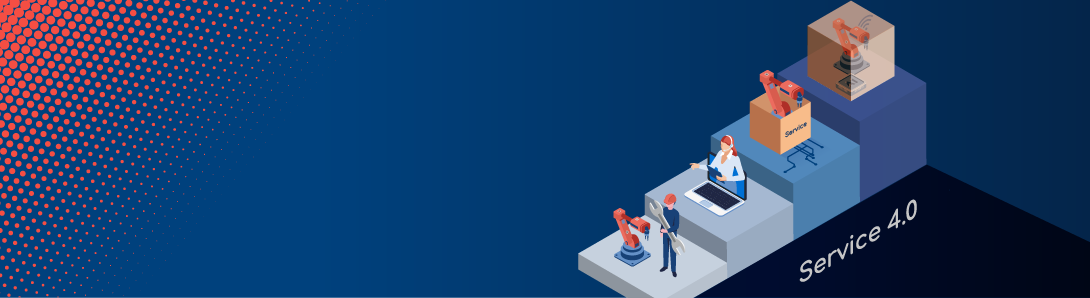
The path to Service 4.0 runs through four levels, from service as support for sales to service as a product in its own right. Each higher level opens up new revenue opportunities while placing greater demands on data, processes, and collaboration across the company. If you know your level, you can set realistic goals for the next step.
| Service level | Role of service | Typical services | Limits of this level |
| Service 1.0 Sales support | supports the sale of new machines and solves problems | technician visits, availability by phone, and spare parts delivery | no additional revenue and disconnected data |
| Service 2.0 Product-related service | a revenue stream of its own beyond the sale of machines | training videos, remote services, and upgrades | only rudimentary data connectivity and thus a risk of incorrect orders |
| Service 3.0 Connected service | package of machine and service | operating data and predictive maintenance | operating data is available but not linked to bills of materials and documentation |
| Service 4.0 360° service | service as a standalone product | data-based business models and a service platform | high ongoing effort to operate and further develop the service business model |
You can read more about individual services in our articles on remote services in aftersales and predictive maintenance.
According to Boston Consulting Group, only 4 percent of the companies surveyed say they have successfully generated recurring revenue from digital services so far. So even among large manufacturers, most are still on their way. Our checklist of 12 statements helps you take an honest look at where your own service stands today.

How do manufacturers reach the next service maturity level?
Manufacturers reach the next service maturity level step by step, starting with an honest as-is analysis of their service business. This forms the basis for realistic goals that don’t jeopardize day-to-day operations. Also crucial are connected service information, critically reviewed processes, and an organization that backs the transformation as a whole.
Four points help with planning:
Start with an as-is analysis and plan investments with realistic goals
Challenge processes and redesign them where needed
Involve the entire company, beyond aftersales and sales
Define metrics for progress in advance, such as follow-up questions in service or incorrect orders
Typical objections are that the data is too poor, there’s no time for a complex rollout, or the team won’t embrace the change. In our view, this is exactly why a gradual start in a manageable area makes sense. For example, you could start with a single product series or initially only with spare parts identification. That keeps the effort limited, and the team sees the benefits early on.
When you digitalize your aftersales, the process starts with saying goodbye to paper catalogs, handwritten notes, and orders by phone or fax. A digital spare parts catalog eliminates media breaks, and service technicians and customers alike can identify spare parts faster and order them.
A scenario with a machine that triggers its own service ticket
In a simplified scenario, a machine at the customer’s site reports an impending defect and triggers a service ticket by itself. The service technician connects to the machine remotely, checks the relevant service information, and identifies the required spare part. The technician schedules the maintenance with the customer for a convenient time, so there is no unplanned downtime. The customer then orders spare parts themselves in the customer portal, so remote services, predictive maintenance, and self-service work hand in hand. Compared with today’s process, this eliminates a second technician visit and incorrect orders.
Implement Service 4.0 step by step
Service 4.0 is a goal that manufacturers reach in several stages. If you know which service level your company is at, you can plan the next step with focus and realistic goals. At every level, connected service information forms the basis for new services and efficient processes. Since the Data Act, this matters even more, because good digital service keeps customers with the manufacturer.
The Quanos IQ Platform brings together scattered knowledge about documentation, spare parts, and service processes. The platform makes it available to technicians, customers, support staff, and maintenance teams at the right moment. Our checklist gives you an initial indication of your own level. Do the quick check now!


